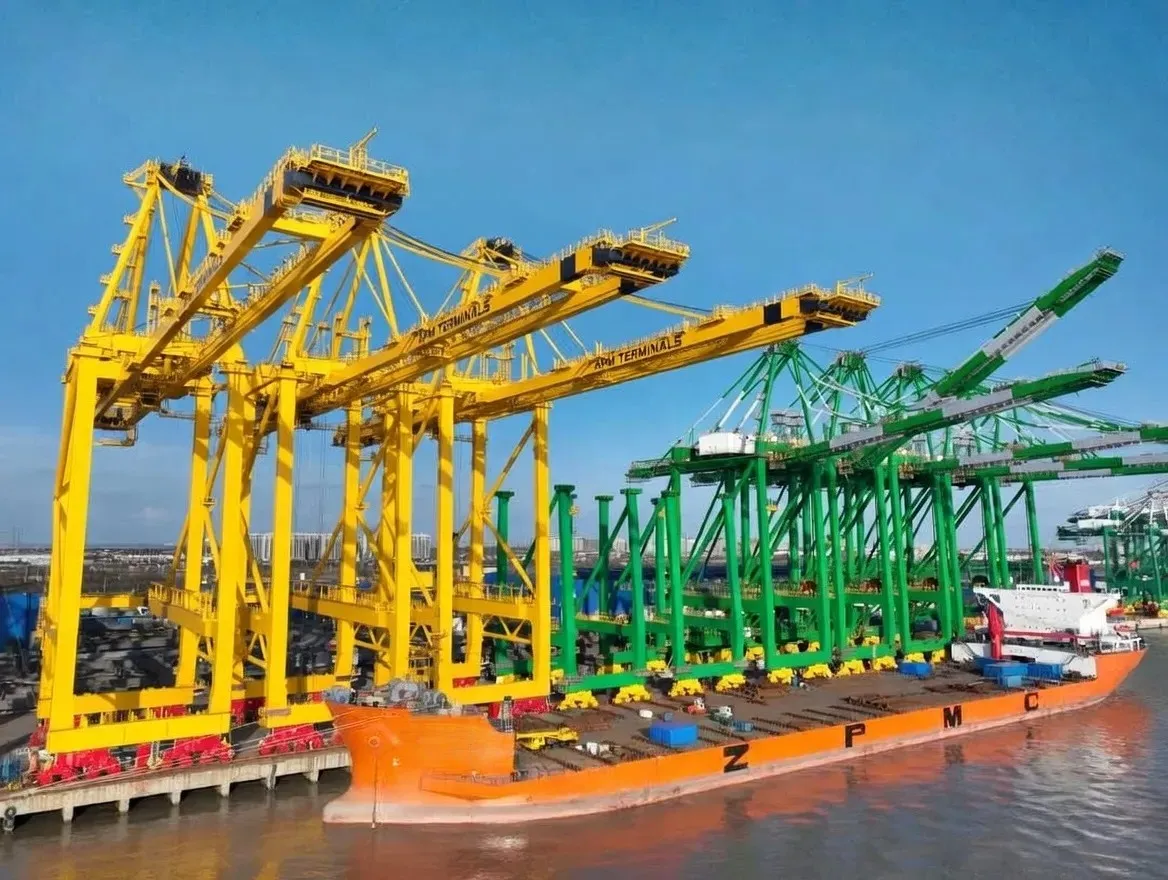
 Port operations across the United Kingdom have shifted dramatically over the last two decades. Container vessels calling at the Port of Felixstowe — the country’s single largest box terminal and handling upwards of four million TEUs in a busy year — arrive deeper in draft, broader in beam, and stacked higher on deck than anything the original crane specifications anticipated. At every berth, the quay crane stands as the gatekeeper between a vessel’s schedule and the terminal’s throughput commitments, and within that crane, the hoisting chain carries the full weight of operational credibility. Mega Chain has spent eighteen years engineering high-performance chain systems specifically calibrated for the punishment that UK port environments deliver: salt-laden estuary air, extreme load cycling across three-shift operations, fluctuating humidity, and the uncompromising regulatory framework of the Lifting Operations and Lifting Equipment Regulations 1998 — LOLER — enforced by the Health and Safety Executive throughout British workplaces. Whether the application is a single-beam harbour crane at a modest coastal wharf or a tandem-lift STS crane at a deepwater container berth, the hoisting chain remains the component whose performance determines system uptime, safe working load integrity, and the maintenance cost trajectory over a service life measured in millions of cycles.
What separates a Mega Chain hoisting solution from a standard market alternative is not simply raw tensile strength — though that is exceptional — but the intersection of metallurgical precision, geometric accuracy, and documented traceability that UK port procurement teams and HSE-regulated inspection bodies consistently require. Every chain leaving our production facility carries a full mill certificate, proof-load test record, and batch traceability reference number, fully satisfying the requirements of EN 818-2, EN 818-4, and where required by specialist offshore or third-party classification society specifications, additional certification layers. For an operations director managing crane availability at a 24-hour container terminal, unplanned downtime translates directly into vessel delays, demurrage charges, and contractual penalty exposure. Mega Chain chains are built so that downtime remains a scheduled maintenance event rather than a reactive emergency — and our UK port customers have the inspection data and the service-life records to prove it.
The Engineering Reality of Quay Crane Hoisting Demands
Why standard chain fails where Mega Chain excels — in the most demanding UK port environments
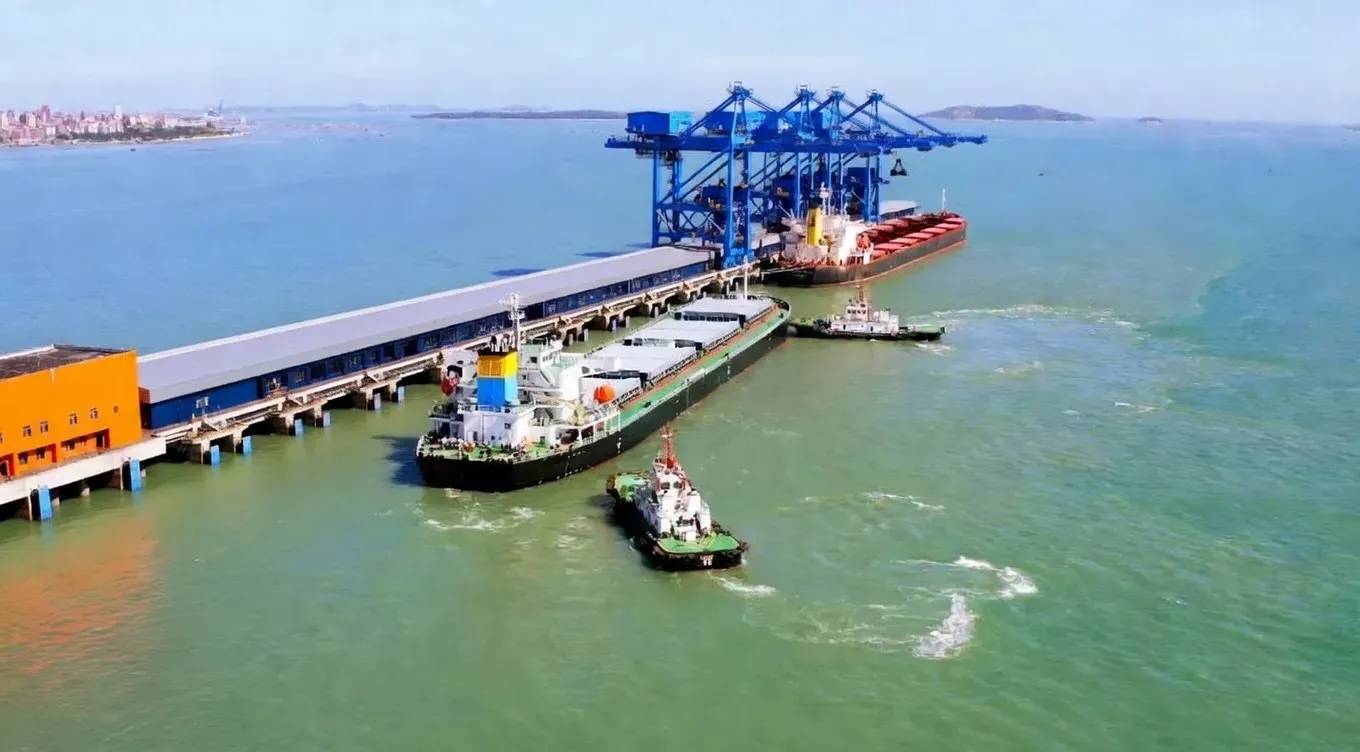 A modern ship-to-shore crane servicing a Triple-E class container vessel operates under conditions that will reduce an under-engineered hoisting chain to scrap metal within weeks. Hoist heights routinely exceed 45 metres above quay level, outreach stretches beyond 65 metres over the vessel’s deck, and rated lift capacities on contemporary STS cranes range from 65 tonnes for standard single-pick operations to well over 100 tonnes in tandem-lift configuration. At major UK deepwater terminals — London Gateway in the Thames Estuary and Southampton’s Berth 204 among them — crane cycles regularly exceed 30 container moves per hour per machine, across continuous three-shift patterns seven days a week. That arithmetic produces more than 250,000 full-load hoist cycles within a single calendar year for one crane alone. The cumulative fatigue, wear elongation, corrosion exposure, and bearing surface degradation that accumulates across that volume of cycling demands chain that has been engineered for the application rather than selected from a generalist catalogue.
Mega Chain’s quay crane hoisting chain begins with Grade 80 and Grade 100 alloy steel produced to tightly controlled chemical composition specifications, then undergoes a through-hardening heat treatment cycle that achieves a precisely managed hardness profile. The balance between tensile strength and ductility is critical — over-hardened chain achieves headline breaking-force numbers but sacrifices the elongation that allows the link to deform visibly before fracture, eliminating the visual warning that experienced crane inspectors rely on during LOLER thorough examination. Pitch tolerance across the working length is held to within ±0.1%, a specification that is non-negotiable in calibrated chain hoist systems: pitch error accumulates across each engaged sprocket tooth and translates directly into shock loading, accelerated sprocket wear, and chain tracking failures that cascade into more expensive repairs. The bearing contact surfaces between link side plates receive a specialist surface treatment that extends lubrication retention and resists the chloride-rich atmospheric ingress that characterises every UK estuary and coastal port environment.
Grade 100 Alloy Steel Core
Heat-treated G100 alloy steel delivers minimum breaking forces far exceeding standard chain at equivalent diameter, enabling leaner crane system designs without any reduction in the safety factors demanded by UK lifting regulations and Lloyd’s Register class requirements.
Pitch Precision at ±0.1%
Sub-millimetre pitch accuracy maintained across the entire working length ensures smooth, consistent engagement with crane drive sprockets. This eliminates the shock loads that progressively destroy bearing surfaces, sheave flanges, and drum grooves in high-cycle port crane applications.
Marine-Grade Corrosion Protection
Specialist polymer surface treatment and optional hot-dip galvanising provide robust, layered protection against the chloride-saturated, humidity-variable conditions found at UK estuary terminals on the Thames, Humber, Mersey, and Severn, extending lubrication intervals and reducing inspection-triggered chain rejections.
Full EN 818 Cert & LOLER Traceability
Every batch is fully traceable from raw material melt to finished product, with proof-load test certificates and mill certificates supplied as standard on every order. Documentation is formatted to satisfy LOLER 1998 thorough examination requirements and HSE Written Report of Examination templates without additional reformatting.
Technical Performance Specifications
Typical specification range for Mega Chain quay crane hoisting chains. Custom configurations — including non-standard pitch, bespoke link geometry, and specialist coating systems — are available on request from our application engineering team.
| Parameter | Grade 80 (G80) | Grade 100 (G100) | Grade 120 (G120) |
|---|---|---|---|
| Chain Diameter Range | 6 – 32 mm | 6 – 32 mm | 6 – 22 mm |
| Min. Breaking Force (13 mm dia.) | 160 kN | 200 kN | 250 kN |
| Working Load Limit – SWL (13 mm) | 4,000 kg | 5,000 kg | 6,300 kg |
| Steel Tensile Strength | 800 N/mm² | 1,000 N/mm² | 1,200 N/mm² |
| Elongation at Break | ≥ 20% | ≥ 15% | ≥ 12% |
| Pitch Tolerance (over working length) | ±0.15% | ±0.10% | ±0.10% |
| Standard Surface Treatment | Shot-blasted + zinc phosphate | Shot-blasted + polymer coating | Shot-blasted + HDG option |
| Applicable Standard | EN 818-2 / EN 818-4 | EN 818-2 / EN 818-4 | EN 818-2 / EN 818-4 |
| Available Supply Length | Up to 1,000 m/coil | Up to 1,000 m/coil | Up to 500 m/coil |
Application Scenarios Across UK Port Crane Operations
The deployment range for Mega Chain quay crane hoisting chains extends considerably beyond the primary hoist mechanism alone. Port equipment engineers and crane maintenance managers consistently identify multiple points within the same crane structure where chain-based lifting and tensioning solutions outperform wire rope equivalents — particularly in confined machinery house spaces, low-headroom reeving arrangements, and situations where scheduled replacement cycles favour the simpler, tool-lighter handling of chain over wire. Recognising this full operational scope allows procurement teams to consolidate their Mega Chain supply arrangement across an entire crane fleet, reducing the number of certified vendors on their approved supplier list, simplifying spare part inventory management, and creating a single documentation audit trail for LOLER compliance reporting. The following scenarios represent the principal deployment points that Mega Chain’s port customer base in the UK consistently specify and re-order against.
Customer Success: Port of Tilbury, Thames Estuary, UK
Case Study — Container Terminal Operations — Essex, England
A 34% Reduction in Unplanned Crane Stoppages Across a Six-Machine STS Fleet
The Thames Terminal at the Port of Tilbury operates six panamax-rated STS cranes handling container and ro-ro traffic on the Thames Estuary, where wind-driven tidal spray and the estuary’s ambient salinity create some of the most challenging atmospheric conditions of any UK inland port. The terminal’s maintenance team had been experiencing a frustrating pattern of hoisting chain stretch and surface pitting corrosion that was progressively compressing planned LOLER inspection intervals — from the target twelve months down to as little as seven in some cases — generating unbudgeted examination costs and reactive operational disruptions that the terminal operations manager described as “the kind of problem that seems minor until it costs you a vessel departure.”
Following a technical consultation with Mega Chain’s application engineering team, the terminal’s engineering manager specified a fleet-wide changeover to Mega Chain G100 polymer-coated hoisting chain across all six cranes, combined with a revised lubrication schedule using Mega Chain’s recommended marine-grade chain lubricant applied at intervals matched to the actual environmental exposure of each crane position. Mega Chain supplied custom-cut coils matched precisely to the working length of each individual crane hoist assembly, with factory-welded end links and swaged master links pre-fitted to eliminate field-joining operations and the additional inspection complications these create under LOLER.
Over the fourteen months following the fleet changeover, the terminal recorded a 34% reduction in unplanned crane stoppages attributable to the hoisting chain system. Planned inspection intervals were successfully extended to eleven months across all six cranes, reducing annual LOLER third-party examination costs and associated maintenance labour. The terminal engineering manager also noted that the batch-traceable documentation package supplied with each Mega Chain delivery had simplified their annual compliance reporting process considerably, reducing the administrative preparation time for HSE inspection visits.
34%
Reduction in unplanned chain-related crane stoppages in 14 months
+4 mo
Inspection interval extension vs previous chain supplier
6
Panamax STS cranes re-equipped with Mega Chain G100 in a single project
What Port Engineers Across the UK Say About Mega Chain
“Managing crane maintenance here for over eleven years, and Mega Chain hoisting chains are among the most consistent performers we have ever sourced. The documentation package alone saves us a full two days of administration per LOLER examination cycle. That is not a minor thing when you are running six cranes and trying to maintain crane availability above 98 per cent.”
James Whitfield
Senior Crane Maintenance Engineer — Thames Estuary Container Terminal, Essex, UK
“The custom-cut lengths and factory-fitted end links meant our engineers completed the chain exchange across three cranes during a single weekend shutdown. With standard coil supply we would have needed two additional shifts just for cutting and end preparation on-site. Mega Chain understood our timeline constraints from the very first technical call, and they delivered exactly what they promised.”
Katarzyna Nowak
Procurement & Technical Manager — Port Equipment Services Ltd, Southampton, UK
“We operate in a tidal estuary environment where standard lifting chain corrodes faster than the books suggest. Switching to Mega Chain polymer-coated G100 hoisting chain cut our annual chain replacement budget by roughly 28 per cent in the first full contract year. The service life data from ongoing inspections suggests that saving will compound further. I would have no hesitation recommending them to any UK port procurement team working to a serious maintenance budget.”
David Carrington
Port Operations Director — Humber Logistics Terminal, Immingham, UK
Custom Chain Engineering for UK Port Crane Projects
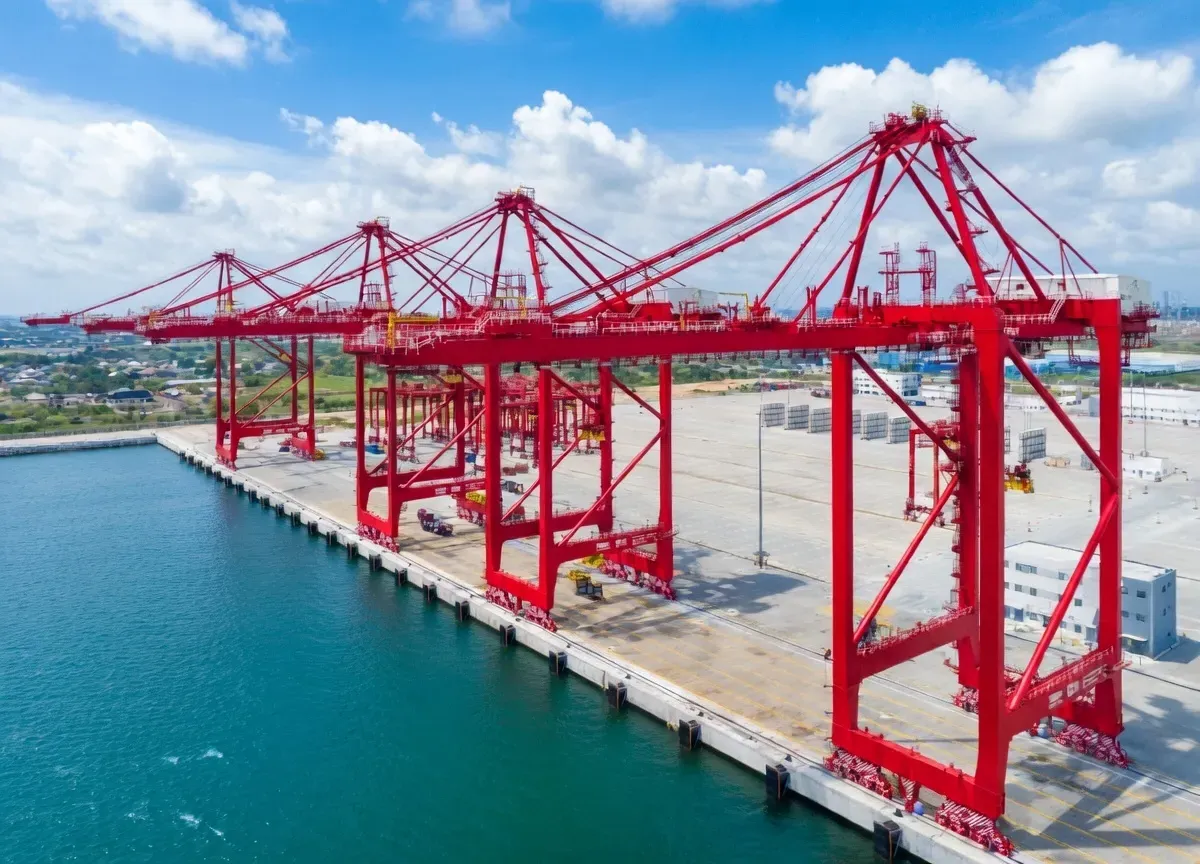 Standard catalogue chain handles the majority of quay crane hoisting requirements without difficulty. Mega Chain’s manufacturing capability, however, extends well beyond what any off-the-shelf offering can deliver. Our production facility runs a dedicated custom chain engineering division staffed by engineers who specialise in crane and lifting applications rather than generalist chain production lines. When a port operator or crane OEM arrives with a specification that falls outside standard parameters — an unusual pitch-to-diameter ratio demanded by a legacy crane drum design, a non-standard link geometry required by a proprietary spreader attachment system, a surface treatment profile dictated by an offshore classification body, a documentation format that must conform to Lloyd’s Register or Bureau Veritas third-party inspection requirements — our engineering team translates that requirement into manufactured product. We do not redirect out-of-standard enquiries to a catalogue; we build the answer.
The custom manufacturing capability at Mega Chain is particularly valued by UK port operators managing mixed-generation crane fleets, where procurement teams routinely face the challenge of sourcing replacement chain for crane models that the original OEM manufacturer no longer supports with genuine spares. Our reverse-engineering service works from worn chain samples, original crane drawings, or dimensional measurements taken directly on-site by the customer’s maintenance team, producing replacement chain that matches the original equipment specification precisely — often with a material grade improvement that extends service life beyond the original design intent without requiring any modification to the crane’s structural or mechanical arrangements. Lead times for custom orders typically run four to six weeks from confirmed specification, and we offer pre-production first-article inspection with a third-party witness option for clients whose internal quality procedures require witnessed factory acceptance. For UK port operators managing capital expenditure and annual maintenance budgets, our flexible order structure — from single-coil evaluation orders through to annual framework supply agreements with call-off delivery scheduling — removes the minimum-order barriers that complicate procurement from conventional chain manufacturers and allows maintenance budget holders to align chain supply with actual consumption rather than storage-inflating bulk orders.
📐
Reverse Engineering
Matched from worn samples, on-site measurements, or legacy drawings. Optional grade upgrade included.
🏭
3rd-Party Witness Inspection
Lloyd’s Register, Bureau Veritas, and DNV witnessed factory acceptance testing available for critical port and offshore projects.
📦
Pre-Cut to Working Length
Delivered ready to install with swaged end links and master links pre-fitted, cutting on-site installation time and eliminating field-joining risk.
📄
Full Documentation Pack
Mill certificates, proof-load test records, and batch traceability supplied as standard on every order — formatted for LOLER compliance from the box.
📈
Framework Supply Agreements
Annual framework contracts with scheduled call-off delivery align chain supply to actual maintenance consumption cycles and simplify procurement administration across large crane fleets.
Frequently Asked Questions
Procurement-ready answers for UK port engineering teams, lifting equipment inspectors, and crane maintenance contractors.
© Mega Chain — Precision Hoisting Chain Solutions for UK Port & Industrial Crane Operations | [email protected]
edit by gzl