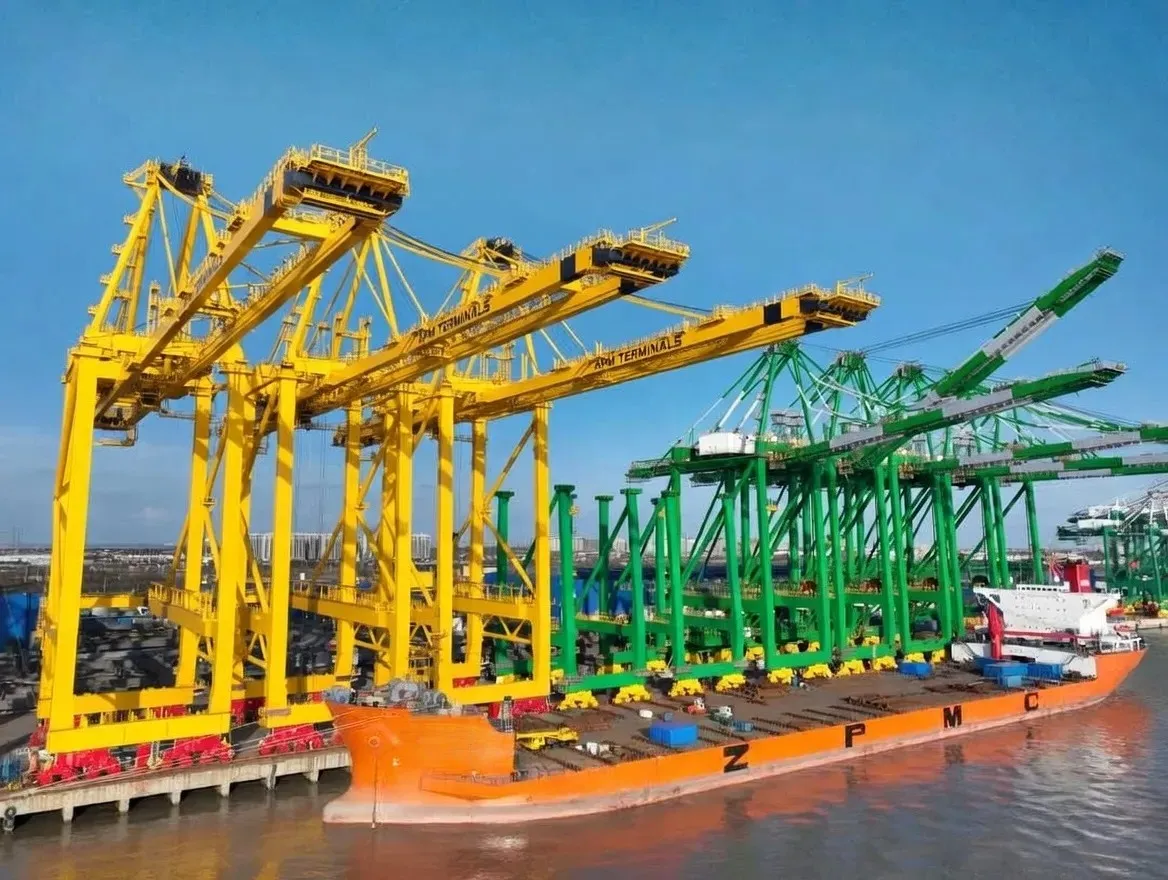
 Every container port in the United Kingdom lives by one metric above all others: crane uptime. When a quay crane stops, so does the berth productivity — and in an industry where vessel turnaround times are measured in hours, not days, a hoisting chain failure on a shore bridge crane sends a ripple of disruption across the entire supply chain. The hoisting chain is the tensile spine of the crane’s lifting mechanism, running through a multi-sheave reeving arrangement that multiplies mechanical advantage and allows the crane spreader to engage, lift, and place containers weighing up to 40 tonnes in a motion that repeats several thousand times each working day.
📧 Request a Quote — [email protected]
Response within 24 hours | UK stock available | Custom specifications welcome
What Is a Quay Crane Hoisting Chain and Why Does Specification Matter?
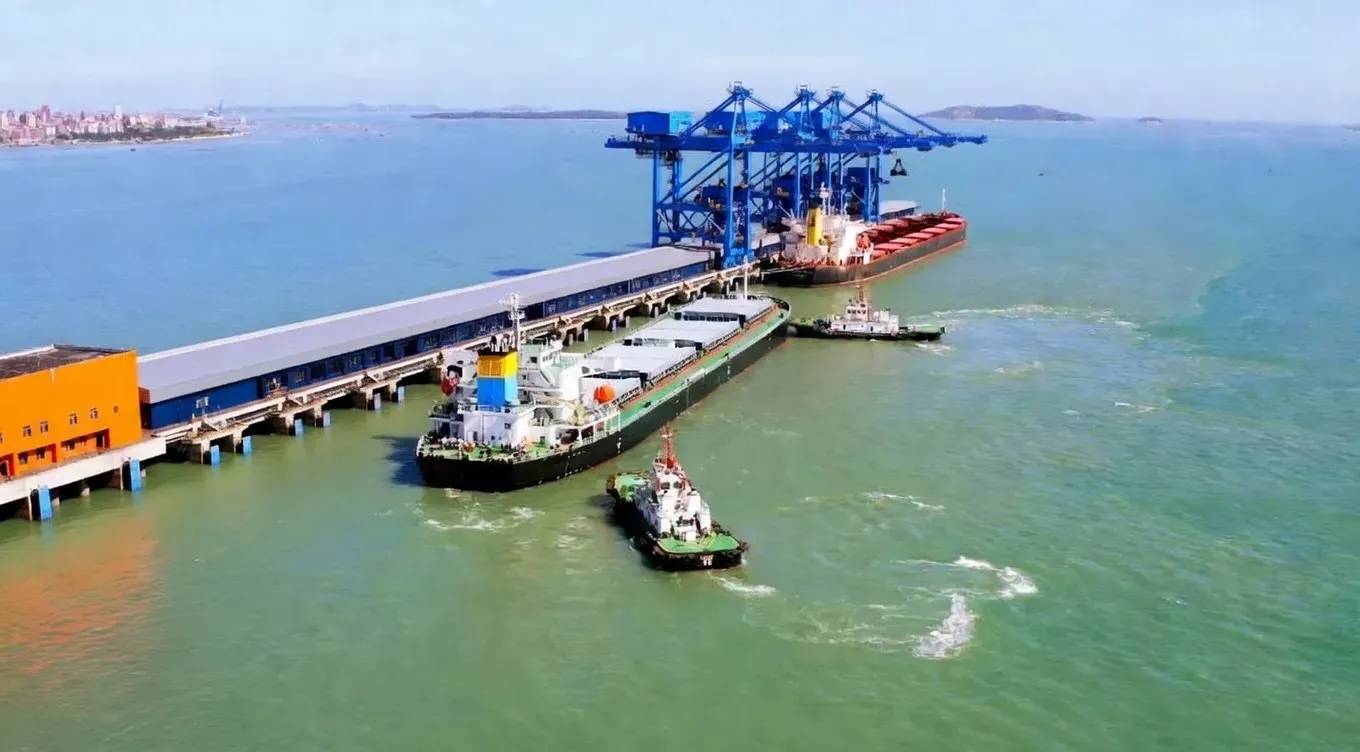 A quay crane — referred to interchangeably in the trade as a shore bridge crane or ship-to-shore (STS) crane — is a portal structure that straddles the quay wall and extends over the vessel’s beam to load and discharge containers. The hoisting mechanism consists of an electrically driven drum, a multi-part reeving of chain through a sheave block assembly, and a lower block carrying the spreader that engages the container’s corner castings. In high-capacity cranes handling super-post-Panamax vessels at terminals like DP World London Gateway or the Port of Felixstowe, the hoisting chain must sustain working load limits exceeding 50 tonnes on a single reeving, while simultaneously absorbing the dynamic shock loads that occur each time the crane operator initiates a lift on a container that may have settled unevenly in the ship’s bay.
What separates a purpose-designed mega chain hoisting assembly from a standard industrial lifting chain comes down to four interlocking engineering factors: alloy grade, heat treatment cycle, pitch accuracy tolerance, and surface protection chemistry. A catalogue-grade G80 chain from a volume distributor may carry an identical printed WLL, but the fatigue life — the number of full-load cycles before crack initiation occurs — can differ by an order of magnitude when the chain is operated in a high-frequency port crane application. A quay crane completing 28 to 35 container moves per hour across a 16-hour operational window accumulates millions of stress cycles in under 12 months. At that rate, the gap between a chain engineered specifically for hoisting duty and one sized only for static rated capacity translates directly into replacement intervals, unplanned downtime costs, and crane availability figures that port operators report to their customers on a monthly basis.
Mega Chain’s hoisting chain assemblies are designed and documented to deliver a minimum of 1,000,000 load cycles at 50% WLL without measurable pitch elongation — a performance threshold that aligns precisely with the maintenance planning cycles adopted by UK’s leading container terminal operators and that is independently verified through fatigue testing conducted in accordance with ISO 3056.
Technical Performance Parameters
All values conform to BS EN 818-7. Data verified through independent third-party testing. Custom diameters and pitches available on request.
Why UK Port Engineers Specify Mega Chain Hoisting Chain
Extended Fatigue Life
Mega Chain’s G100 hoisting chain delivers a documented minimum of 1.5 million load cycles at 50% WLL — a figure supported by independent ISO 3056 fatigue test data. For a busy port crane running 28 container moves per hour across a 16-hour shift, that translates to service intervals measured in years rather than months, dramatically lowering total cost of ownership and unscheduled downtime exposure.
Sub-0.05% Pitch Precision
Pitch deviation is the primary cause of accelerated sprocket wear in quay crane hoisting systems. Mega Chain’s G100 grade is held to a ±0.03% pitch tolerance across the full chain length — tighter than the EN 818-7 standard requires. This precision keeps the chain-to-sprocket engagement correct through the entire service life, protecting the crane’s drive system and avoiding the compound maintenance cost of simultaneous chain and sprocket replacement.
Marine-Grade Corrosion Resistance
UK port environments — particularly east coast terminals exposed to the North Sea salt aerosol and west coast operations alongside the Irish Sea — impose relentless corrosion demands on steel components. Mega Chain’s port hoisting chain is surface-treated with a zinc alloy plate system validated for coastal exposure under BS EN ISO 10684, combined with a proprietary inter-link geometry that minimises water retention and eliminates the crevice corrosion sites that reduce fatigue life in standard chain designs.
Full LOLER 1998 Compliance Pack
Every Mega Chain hoisting chain assembly dispatched to UK customers ships with a documentation pack that includes the mill material certificate with heat number, individual proof load test certificate at 2× WLL, CE declaration of conformity to BS EN 818-7, and a LOLER-ready inspection record template. This isn’t paperwork for paperwork’s sake — it is the exact documentation that competent persons and inspection bodies require when conducting thorough examinations under LOLER 1998, Regulation 9.
Alloy Steel Composition and Heat Treatment Engineering
The alloy specification at the core of Mega Chain’s hoisting chain range is 23MnNiMoCr for G80 grades and a proprietary 20MnCr5+ composition for G100 assemblies. Both alloys are selected for a specific balance of tensile strength, ductility, and fatigue crack growth resistance — properties that must coexist in a chain link that simultaneously carries high static tensile loads and absorbs repeated impact energy. Each batch of raw bar stock arrives at Mega Chain’s production facility with an original mill certificate, and the heat number is tracked through every stage of the production record to the final chain assembly certificate. This full material traceability is not a universal standard among chain manufacturers operating at volume; it is a deliberate specification choice that reflects the safety-critical nature of port crane hoisting and the documentary requirements imposed by LOLER 1998 on lifting equipment used in UK workplaces.
The heat treatment sequence begins with case carburising to a controlled depth of 0.8–1.2 mm, followed by oil quenching to lock the high-carbon martensitic surface structure, and a low-temperature tempering cycle at 180–200°C to relieve residual quench stress while retaining surface hardness above 650 HV. The outcome is a chain link with a hardened outer surface that resists wear at sheave contact points, combined with a tough, ductile core that absorbs impact energy without brittle fracture initiation — a combination that is especially critical during the shock-loading events that occur when a crane operator lifts a container that has settled unevenly in a ship’s cell guide. Each individual link is shot-blasted after heat treatment to remove scale, improve fatigue performance by inducing beneficial compressive residual stresses at the surface, and prepare the substrate for the surface treatment layer.
🔒 Certifications & Standards: EN 818-7 | CE Marking | ISO 9001:2015 | ISO 3056 Fatigue Test | DNV GL Type Approval available | Lloyd’s Register accepted | LOLER 1998 compliant documentation
Application Scenarios Across UK Port Crane Types
Mega Chain hoisting chain is engineered for the full spectrum of port crane applications found at British container terminals, bulk cargo facilities, and roll-on/roll-off berths.
🚢 Ship-to-Shore (STS) Cranes
The primary application for Mega Chain port hoisting chain. STS cranes at UK container terminals such as Felixstowe, Tilbury, and Southampton operate with outreaches of 60 m or more and face the highest combination of working load, cycle frequency, and dynamic shock in the port crane family. G100 hoisting chain in 28–36 mm diameter is the standard Mega Chain recommendation for post-Panamax and super-post-Panamax STS installations.
🛟 Rubber-Tyred Gantry (RTG) Cranes
RTG cranes operating in terminal storage yards complete up to 25 lifts per hour — a higher cycle frequency than STS cranes. The rubber tyre contact with concrete transmits vibration into the crane frame that adds an additional fatigue loading component not present in fixed-structure cranes. Mega Chain’s G80 HD range for RTG hoisting applications is designed around an extended fatigue curve that accounts for this vibration component, consistently delivering over 14 months between pitch-elongation inspections at busy UK terminals.
🔧 Rail-Mounted Gantry (RMG) & Automated Cranes
Automated terminal operations — increasingly common at UK ports adopting Industry 4.0 logistics models — use RMG cranes running with minimal human intervention. An unscheduled hoisting chain failure on an automated RMG shuts down an entire storage lane and triggers a cascade delay that the terminal management system cannot easily redistribute. Chain reliability is therefore non-negotiable, and Mega Chain’s G100 assemblies for RMG hoisting are batch-tested rather than sample-tested, with every individual assembly proof-loaded and logged before dispatch.
⛵ Floating Cranes & Heavy-Lift Harbour Equipment
UK ports operating floating cranes for bulk cargo, project cargo, and offshore logistics face a unique hoisting chain challenge: vessel motion introduces a variable pre-load on the chain that does not exist in fixed-structure applications. The resulting low-cycle, high-amplitude loading profile accelerates fatigue damage at the link crown and inter-link contact points. Mega Chain’s marine-grade G80 and G100 hoisting chain for floating crane applications is specified with an enhanced alloy toughness to handle this combined loading mode, and is supplied with DNV GL or Lloyd’s Register type approval documentation on request.
What UK Port Engineers Say
★★★★★
“The pitch tolerance on Mega Chain’s G100 hoisting chain is noticeably tighter than anything else we’ve sourced in 12 years of crane maintenance at Tilbury. Sprocket wear rates dropped immediately after the changeover, and the certification pack included exactly the LOLER documentation we needed without any chasing.”
James Whitfield
Senior Crane Engineer, Port of Tilbury, Thames Estuary
★★★★★
“Lead times from Mega Chain are consistently shorter than OEM supply channels for replacement hoisting chain, and the technical support when we needed a non-standard pitch for one of our older cranes was exceptional. They came back with a proper application study, not just a catalogue recommendation.”
Sarah Chen
Procurement Manager, DP World Southampton Terminal
★★★★★
“I was sceptical about switching from an established OEM chain supplier, but the cost-per-tonne-lifted analysis Mega Chain produced for our three post-Panamax cranes made a compelling case. Fourteen months into the contract, the field data supports every claim they made at the tender stage.”
Tom Hartley
Operations Director, Bristol Port Company
Manufacturing Capability and Custom Chain Production
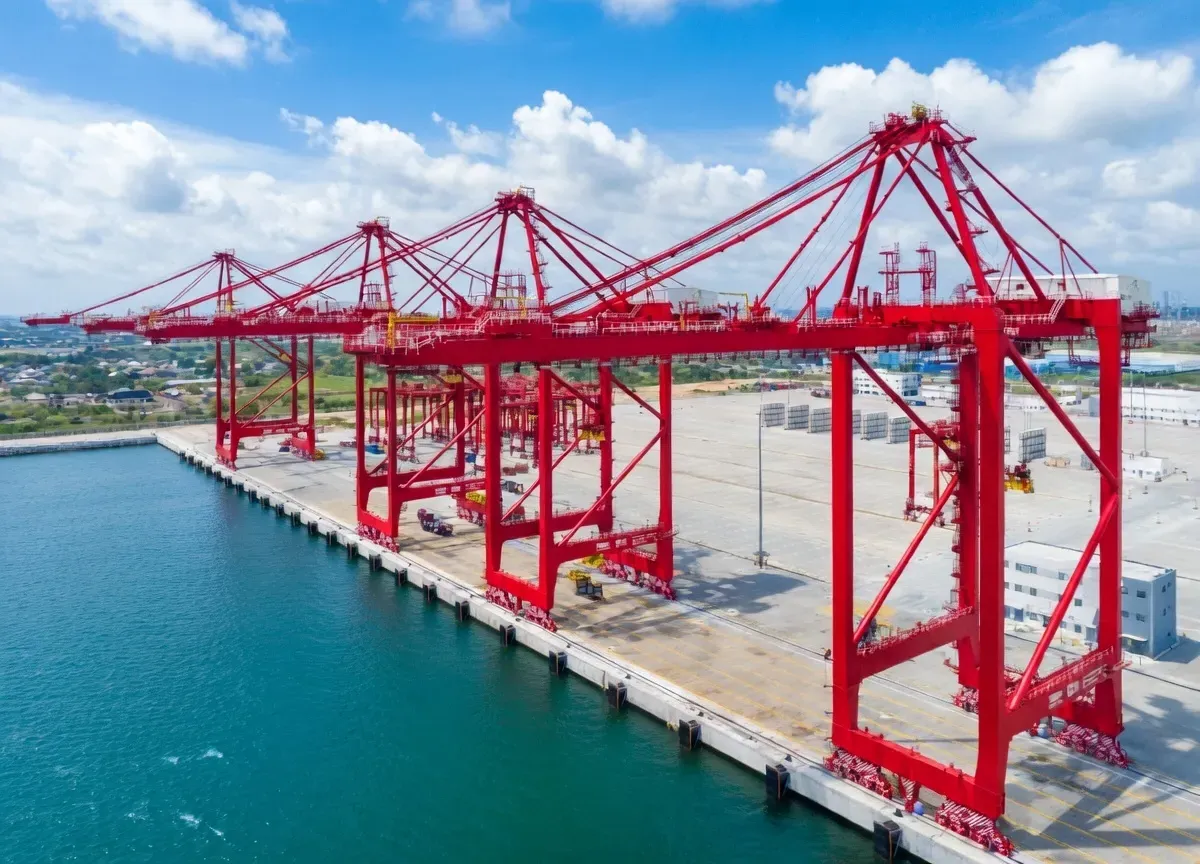 Mega Chain’s manufacturing facility operates to ISO 9001:2015 quality management standards and maintains a dedicated port crane hoisting chain production line capable of producing finished assemblies in diameters from 10 mm to 64 mm across both G80 and G100 grade classifications. The facility’s investment in CNC chain link forming machines, induction hardening lines, and automated pitch gauging equipment supports a level of dimensional consistency that is not achievable on general-purpose chain production equipment — and that is precisely why Mega Chain’s pitch tolerance figures can be guaranteed rather than merely targeted.
For UK port operators with legacy shore bridge cranes originally supplied by European or Asian crane OEMs, the customisation capability is often the deciding factor in the supplier selection process. Many older STS cranes operating at UK quaysides — particularly units installed during the containerisation boom of the late 1980s and 1990s — were built around proprietary chain specifications that the original OEM’s service network no longer stocks as a standard item. Mega Chain‘s application engineering team can work from a physical chain sample, a dimensional drawing, or even a crane model number to identify the equivalent hoisting chain specification, produce a conforming replacement assembly to EN 818-7 or applicable equivalent, and deliver it with a CE declaration of conformity and a LOLER-compatible test certificate that satisfies UK inspection requirements without qualification.
The customisation service extends to complete hoisting chain assemblies with integrated master links, C-hooks, swivel connections, and spreader attachments — every component individually proof-loaded and certificated to the same standard as the chain itself. For multi-crane fleet operators managing inventory across terminals at Felixstowe, London Gateway, Liverpool, Southampton, or any other UK port location, Mega Chain offers a fleet supply programme that consolidates ordering under a single technical reference framework, simplifies spares inventory management, and provides a dedicated account manager with direct knowledge of your crane fleet specifications and maintenance schedule.
Custom Order Capabilities at a Glance:
Non-standard pitch & diameter · Bespoke end terminations & master links · Special surface treatments for extreme marine environments · Hot-dip galvanised option for exposed deck applications · OEM reverse-engineering from sample or drawing · CE + LOLER documentation as standard · DNV GL / Lloyd’s type approval on request · 10–15 business day lead time for custom UK orders · Express production available for urgent port replacements
Get a Quote → [email protected]
Send your chain diameter, grade, pitch, and total length | 24-hour UK response guaranteed
Frequently Asked Questions
Real questions from UK port engineers and procurement teams — answered directly by Mega Chain’s application engineering specialists.
What is the best mega chain grade for STS quay crane hoisting operations at a container port in the UK?
For ship-to-shore crane hoisting at UK container ports — including Felixstowe, Tilbury, London Gateway, and Liverpool — Grade 100 (G100) to BS EN 818-7 is Mega Chain’s standard recommendation. G100 hoisting chain delivers a working load limit approximately 25% higher than an equivalent G80 assembly at the same physical chain diameter, meaning you achieve the rated crane capacity with a lighter, smaller-diameter chain. The reduced dead weight directly lowers the inertia load on the hoisting drive motor and sheave system, improving crane energy efficiency. For cranes already designed around G80 chain geometry and sprocket pitch, upgrading to G100 in the identical physical size extends hoisting chain service life by a meaningful margin without requiring any modification to the crane’s existing drive or reeving hardware.
How much does a mega chain hoisting chain assembly cost for a shore bridge crane in the UK, and what is the best way to get an accurate price quote?
The cost of a complete quay crane hoisting chain assembly in the UK depends on the chain diameter, grade (G80 or G100), surface treatment specification, total reeving length, and end termination type. A representative G100 replacement hoisting chain assembly for a mid-capacity STS crane — including master links, end hooks, and a full LOLER documentation pack — typically falls in the range of £12,000 to £26,000. The most accurate way to obtain a UK-specific price and delivery confirmation is to email the crane’s chain specification (OEM model number, chain diameter, pitch, current supplier reference, and total chain length required) directly to [email protected]. Mega Chain’s team will confirm the exact equivalent specification and return a formal written quotation within 24 hours of receiving complete technical details.
Where can UK port operators find a certified mega chain supplier for quay crane hoisting chain with fast delivery to English and Scottish ports?
Mega Chain maintains accessible stock of the most commonly specified hoisting chain diameters and grades, with confirmed fast dispatch for standard G80 and G100 sizes to all UK mainland port locations — including ports in England, Scotland, and Wales. For terminals requiring an urgent hoisting chain replacement, Mega Chain can typically confirm stock availability and dispatch logistics on the same business day the enquiry is received. All assemblies supplied to UK customers include the full LOLER-compatible documentation package — material certificate with heat number, individual proof load test certificate, and CE declaration of conformity — as a standard inclusion with every order, not an optional add-on. Contact [email protected] or visit www.mega-chain.com to confirm availability for your specific crane requirement.
Which mega chain specification is required to comply with LOLER 1998 regulations for shore bridge hoisting chain at UK container terminals?
LOLER 1998 (Lifting Operations and Lifting Equipment Regulations) requires that all lifting equipment, including hoisting chain on port cranes, is suitable for its intended purpose, of adequate strength, and marked with the safe working load. The recognised technical standard for load chains in the UK is BS EN 818-7. Mega Chain’s entire port hoisting chain range is manufactured and tested to EN 818-7, supplied with a proof load test certificate confirming testing to 2× WLL, and permanently marked with the chain diameter, grade designation, WLL, and standard reference on the end master links. This documentation and marking package is accepted by all UK LOLER inspection authorities, insurance surveyors, and crane certification bodies, and satisfies the LOLER Regulation 9 thorough examination documentation requirements without supplemental paperwork.
How often should mega chain hoisting assemblies be formally inspected on quay cranes at UK container ports, and what are the rejection criteria?
Under LOLER 1998, lifting chains on port cranes must undergo a thorough examination by a competent person at least every six months, or at shorter intervals if specified by the competent person’s written examination scheme. In practice, most UK port operators add interim visual inspections and pitch elongation measurements at three-month intervals as part of their planned preventative maintenance programme. Mega Chain recommends initiating replacement when pitch elongation (measured over a 10-link gauge length) reaches 2% — a more conservative threshold than the EN 818-7 maximum of 3% — reflecting the higher consequence of hoisting chain failure in an active port environment. Mega Chain supplies calibrated pitch measurement tools and standardised inspection record templates as part of the standard chain supply package for UK customers, supporting compliant documentation practices under LOLER’s examination record requirements.
What specifically makes a mega chain port hoisting chain different from standard G80 lifting chain when used in coastal marine environments like UK docks?
Standard G80 lifting chain from a general industrial distributor is engineered for primarily dry, indoor use in factories, warehouses, and construction applications. Port hoisting chain operates in a permanently coastal environment — the North Sea east-coast exposure at Felixstowe or Tilbury, the Irish Sea conditions at Liverpool, or the Bristol Channel at Avonmouth — where salt aerosol deposition is continuous, humidity fluctuates widely, and intermittent rain cycles create the wet-dry cycling that accelerates crevice corrosion in the contact zones between chain links. Mega Chain’s port hoisting chain uses an enhanced alloy grade with improved corrosion resistance, a surface treatment specification validated for coastal salt environments under BS EN ISO 10684, and a link geometry that minimises trapped water in inter-link contact zones — all of which measurably reduce pitting corrosion and extend the fatigue life of the chain in the specific conditions found at British port locations.
Can I order custom-length mega chain hoisting chain assemblies made to a non-standard pitch for my specific quay crane at a UK port?
Yes — custom-length and non-standard-pitch hoisting chain assemblies are one of Mega Chain’s core manufacturing capabilities. Whether you need a direct replacement for a proprietary OEM hoisting chain with a non-standard pitch dimension, a bespoke assembly with specific end termination types for an older European-built STS crane, or a complete chain set configured for a particular reeving arrangement at a UK port terminal, Mega Chain’s engineering team works from your dimensional data or a physical chain sample to produce a conforming replacement assembly. Custom orders for UK port customers typically require a 10–15 business day lead time from order confirmation to dispatch, with an express production route available for urgent crane-off situations. Send your technical details or a sample to [email protected] to begin the process.
MEGA CHAIN · PORT CRANE HOISTING SPECIALISTS · UNITED KINGDOM
Ready to Specify the Right Hoisting Chain for Your Quay Crane?
Send your crane specification — OEM model, chain diameter, pitch, grade, and total length — and receive a formal quotation with full LOLER documentation within 24 hours.
📧 Get a Quote — [email protected]
Serving port crane operators across England, Scotland, Wales | Custom specifications welcome | Stock items dispatched same day
edit by gzl