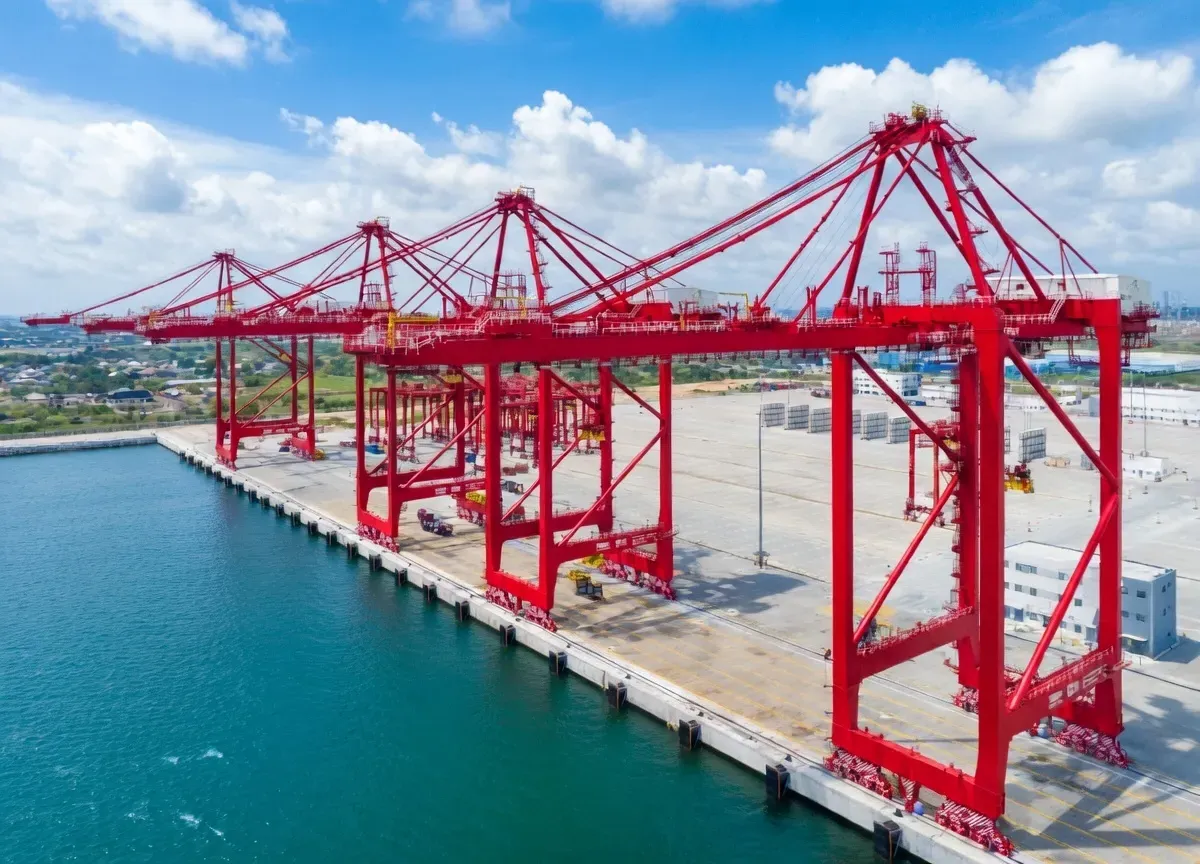
 Ship-to-shore cranes — universally recognised as quay cranes or shore bridge cranes — represent the defining infrastructure of modern containerised port logistics. At facilities like the Port of Felixstowe, the busiest container terminal in the United Kingdom, these towering machines execute thousands of container moves every single day, and their reliability is absolutely non-negotiable. Deep within the mechanical architecture of every quay crane lies the hoisting system: a precision assembly of drums, sheaves, and — critically — the hoisting chain responsible for controlled vertical movement under full load. The performance of that hoisting chain determines how safely and reliably the crane operates across its entire service life. And it is precisely here where Mega Chain hoisting chains define the standard.
Mega Chain has invested close to two decades refining the engineering of industrial hoisting chains, combining advanced alloy steel metallurgy with precision link geometry and rigorous quality protocols to produce lifting chains that consistently exceed rated working loads under authentic port operating conditions. Unlike generic commercial chain supply, Mega Chain hoisting chains are developed with an intimate understanding of the unique mechanical environment inside a shore bridge crane — the cyclic load reversals, the acceleration-induced dynamic amplification, the coastal corrosive attack, and the requirement for dimensional consistency across every single link in a continuous chain assembly. Terminal engineers who have specified Mega Chain products know that when the hook rises and falls through hundreds of thousands of operational cycles, the hoisting chain must perform without question. Failure is simply not an acceptable outcome in a live port environment.
This article examines why hoisting chain selection is one of the most consequential decisions a quay crane maintenance manager can make, how Mega Chain engineering addresses the specific failure modes of shore bridge crane lifting systems, and why port operations from Southampton and Felixstowe to the Humber, Teesport, and the Scottish west coast are increasingly specifying Mega Chain as their trusted hoisting chain supplier. Whether you are planning a scheduled maintenance replacement, engineering a new crane installation, or responding to an urgent operational requirement, the information here will help you make the right specification decision the first time.
Why Hoisting Chain Quality Defines Port Crane Performance
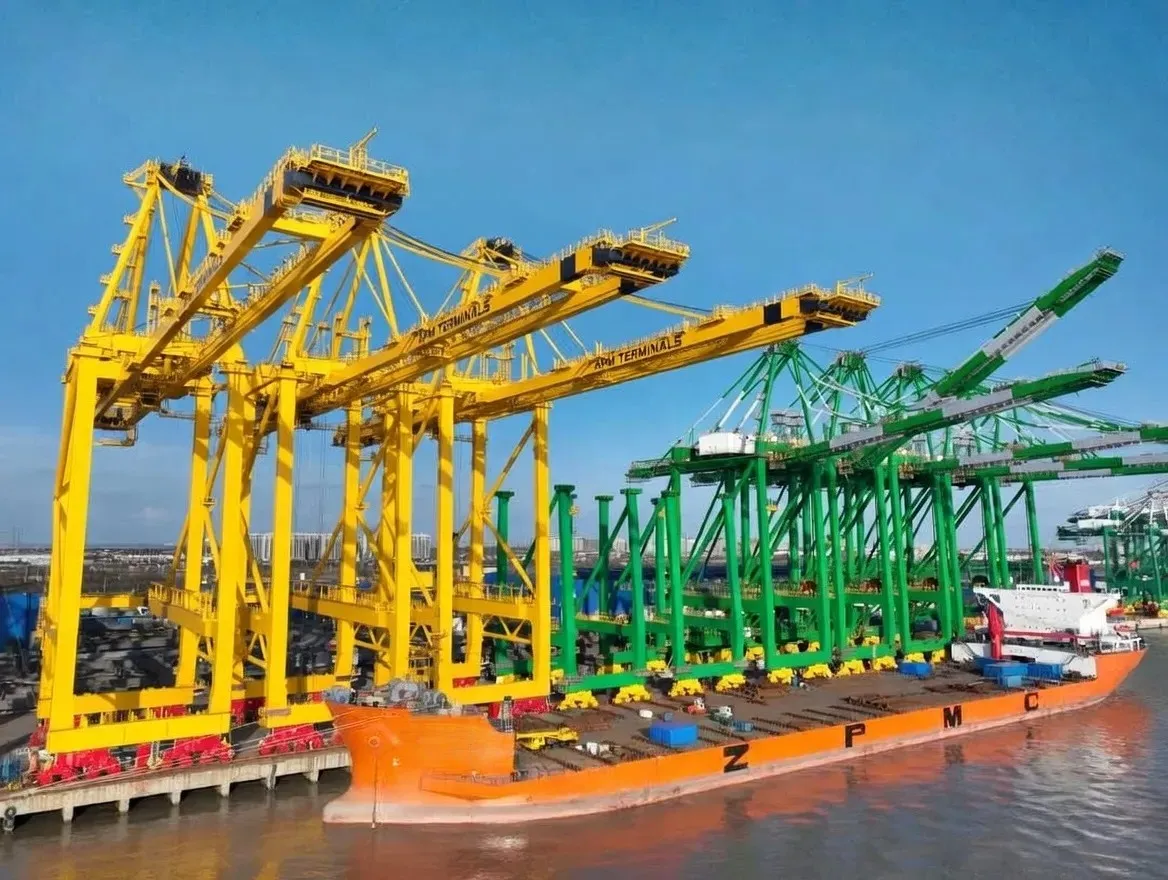
 The hoisting mechanism of a quay crane operates under conditions that would destroy inadequately specified chain products within months. Consider the operational environment: salt-laden air accelerates corrosive attack on all exposed metal surfaces; ambient temperatures swing dramatically between pre-dawn winter conditions and summer operational peaks; and the hoisting chain endures hundreds of load cycles every working hour across an operational year of relentless productivity demands. Each lift cycle imposes direct tension, bending fatigue at the sheave contact points, and inter-link wear that progressively degrades chain cross-section and increases pitch. A shore bridge crane handling loaded 20-foot containers weighing up to 50 tonnes generates enormous dynamic amplification forces within the hoist chain during acceleration and deceleration phases — forces that static load ratings alone cannot adequately characterise or predict.
In this operating context, selecting a hoisting chain is not merely a procurement transaction; it is a risk management decision with significant financial and safety implications. The consequences of premature chain failure on a quay crane extend far beyond the replacement cost of the chain itself. Unplanned downtime at a container terminal is routinely costed at tens of thousands of pounds per hour when vessel delay penalties, port throughput losses, and crane repair costs are combined. Chain failure resulting in damage to the crane hoist machinery escalates remediation costs by orders of magnitude. And the safety implications of a hoist chain failure with a loaded spreader above vessels, cargo, and personnel represent a potentially catastrophic event that no port operator can afford to contemplate.
Mega Chain engineering addresses every one of these risk factors in a systematic, engineering-led manner — through controlled alloy steel specification, precision manufacturing geometry, comprehensive heat treatment protocols, and rigorous quality assurance at every stage of production. The result is a hoisting chain product that port operators across the United Kingdom have learned to trust over service lifetimes measured in millions of operational cycles, not months.
Technical Performance Parameters
Mega Chain hoisting chains for quay crane and shore bridge applications are manufactured across multiple grade standards and dimensional configurations to match specific crane models and operational duty profiles. All values comply with ISO 1835, EN 818-7, and applicable FEM crane duty classifications. Custom configurations are available — contact our engineering team directly.
Engineering Advantages That Set Mega Chain Apart
A hoisting chain may look like a simple series of steel links. In practice, the performance difference between a generic chain and a properly engineered Mega Chain hoisting chain manifests across six critical dimensions — each of which has a direct financial consequence across the operational life of a quay crane.
Superior Fatigue Life
The inter-link contact geometry in a Mega Chain hoisting chain is engineered using finite element analysis to minimise stress concentration at the bearing surface. Each link profile is precision-optimised to distribute bending loads across the widest possible contact arc during sheave transit — the primary location of fatigue crack initiation in hoisting chains operating at high cycle frequencies. Independent laboratory pulsator testing validates fatigue lives exceeding two million cycles at 50% of minimum breaking load, a performance benchmark that directly translates into extended service intervals and substantially lower lifetime maintenance cost for crane operators across the UK.
Corrosion Engineering
Port environments rank among the most aggressive corrosive conditions for steel lifting components. Salt fog, high humidity, and periodic contact with seawater create conditions under which unprotected or poorly coated chain deteriorates rapidly. Mega Chain hoisting chains are available with multiple corrosion protection systems selected to match the specific exposure severity of individual port locations. Hot-dip galvanising delivers sacrificial zinc protection for high-exposure waterfront environments; electroless nickel plating provides a harder, more dimensionally stable finish for enclosed hoist system applications; and proprietary phosphate-oil treatments deliver baseline protection combined with superior lubricant retention at inter-link contact surfaces. All coatings are applied post-manufacture and independently verified to ASTM B117 salt spray standards.
Dimensional Precision
In a quay crane hoisting system, the chain’s interaction with sprockets, sheaves, and load pins demands dimensional consistency far beyond general industrial tolerances. Any pitch variation or cross-sectional diameter deviation creates uneven load distribution across the sheave assembly, accelerating both chain and sheave wear simultaneously. Mega Chain maintains pitch tolerances of ±0.5% and cross-sectional tolerances of ±0.3% throughout each production run — achieved through precision-controlled cold drawing of feed wire, automated link forming, and 100% dimensional inspection at final quality gate. Every batch shipment is accompanied by a dimensional measurement certificate traceable to national calibration standards, supporting your crane’s planned maintenance documentation requirements.
Full Traceability & Certification
Port operators and terminal maintenance managers increasingly operate within ISO 9001 quality management frameworks, planned maintenance systems, and the requirements of classification societies. Mega Chain supports these requirements with a comprehensive documentation package for every order: material test certificates to EN 10204 3.1, proof load test certificates with individual chain serialisation, dimensional inspection reports, and a certificate of conformity to the applicable chain standard. Classification society witness testing by Lloyd’s Register, Bureau Veritas, or DNV is available by prior arrangement. This complete documentation chain provides the full audit trail required for planned maintenance records, insurance compliance, and flag state requirements.
Custom Lengths & Configurations
Crane maintenance programmes rarely align perfectly with standard commercial chain packaging. A hoisting chain replacement may require a specific length measured to the nearest link, end terminations in a non-standard configuration, or a particular combination of pitch and grade unavailable from catalogue stock. Mega Chain operates a dedicated custom manufacturing service accommodating length requirements from a single metre to multi-hundred-metre continuous drums. End fittings — masterlinks, connecting links, swivel hooks, and crane-specific termination assemblies — are manufactured in-house and proof-loaded as a complete assembled unit prior to dispatch. UK stocking arrangements are available for key accounts requiring same-day call-off to support urgent crane maintenance requirements.
Application Engineering Support
Mega Chain’s relationship with port crane customers extends well beyond the initial supply of chain. Our application engineering team provides pre-order consultation to confirm chain grade, pitch, and configuration against the crane’s design specification and duty classification. Post-installation, we offer wear inspection protocols and chain retirement criteria guidance aligned with ISO 4309 and FEM 9.511 standards. For crane operators considering a transition from wire rope hoist systems to chain hoist systems — a trend driven by improved reliability and reduced maintenance requirements — Mega Chain engineers provide conversion feasibility assessments and can liaise directly with crane OEM engineering teams throughout the specification process. Reach our team at [email protected].
The Material Science Behind Every Mega Chain Link
 The performance of any hoisting chain begins at the molecular level — in the specific alloy steel from which it is manufactured. Mega Chain uses 18CrNiMo7-6 and 34CrNiMo6 alloy steels — both high-tensile, heat-treatable compositions containing chromium, nickel, and molybdenum. These alloying elements work in concert to deliver the precise combination of mechanical properties demanded by dynamic hoisting applications. Chromium raises hardenability and improves baseline corrosion resistance; nickel substantially increases toughness at low temperatures, preventing brittle fracture during cold maritime operating conditions; molybdenum stabilises the tempered microstructure and resists any softening that might otherwise develop from frictional heat generated during high-cycle hoist operations.
The manufacturing sequence begins with cold-drawn wire of precisely controlled composition, hardness profile, and surface condition. Wire is formed into links through a fully automated bending process under controlled forming loads, ensuring geometric consistency from the first link to the last link in a production run. Each link then undergoes calibrated flash welding, with weld parameters continuously monitored and logged for every production batch, providing full process traceability.
Post-weld heat treatment — normalising followed by a controlled quench and temper cycle — transforms the weld zone microstructure to fully match the mechanical properties of the parent material, eliminating the weld as a preferential fatigue initiation site. Following heat treatment, each link passes through shot-blast cleaning that simultaneously removes surface scale and induces beneficial compressive residual stresses at the link surface — a well-established technique for extending fatigue life in cyclically loaded steel components under dynamic loads.
The completed chain then passes through proof loading at a minimum of twice the rated working load, with each link subject to individual load hold verification. Any link exhibiting measurable permanent deformation is removed and replaced before the chain advances to final dimensional inspection, surface treatment, and batch certification. The resulting product carries not just a test certificate, but a verifiable manufacturing history traceable to the specific wire heat, welding parameters, and heat treatment batch — the depth of documentation that serious crane operators increasingly demand from their chain suppliers.
Where Mega Chain Hoisting Chain Performs
Port crane operations span a wide spectrum of application types. Each presents a distinct loading profile, environmental exposure, and maintenance regime — and Mega Chain hoisting chain engineering is adapted to meet the requirements of each.
Ship-to-Shore Container Cranes (STS)
The primary application for Mega Chain hoisting chain in UK ports is the STS quay crane — the shore bridge crane of the container terminal waterfront. Here the hoisting chain forms part of the upper block assembly, transmitting load from the machinery house drum to the spreader below. These cranes operate on demanding FEM 4m or higher duty classifications, with the hoisting chain required to withstand several million load cycles between planned maintenance interventions. Mega Chain Grade 100 and Grade 120 chains are the specified products for this demanding application, delivering the fatigue performance and corrosion resistance the environment demands.
Rubber-Tyred & Rail-Mounted Gantry Cranes
Beyond the waterfront STS crane, rubber-tyred gantry cranes (RTG) and rail-mounted gantry cranes (RMG) working in container stacking yards rely on high-performance hoisting chains for their hoist drum assemblies. The duty profile here differs from STS applications — typically lower peak loads but very high cycle frequencies as yard gantry cranes work continuously through stacking and retrieval operations during busy operational periods. Mega Chain medium-pitch Grade 80 and Grade 100 chains provide the optimum combination of strength, dimensional consistency, and service life for this operationally intensive application type.
Bulk Cargo & Multi-Purpose Terminal Cranes
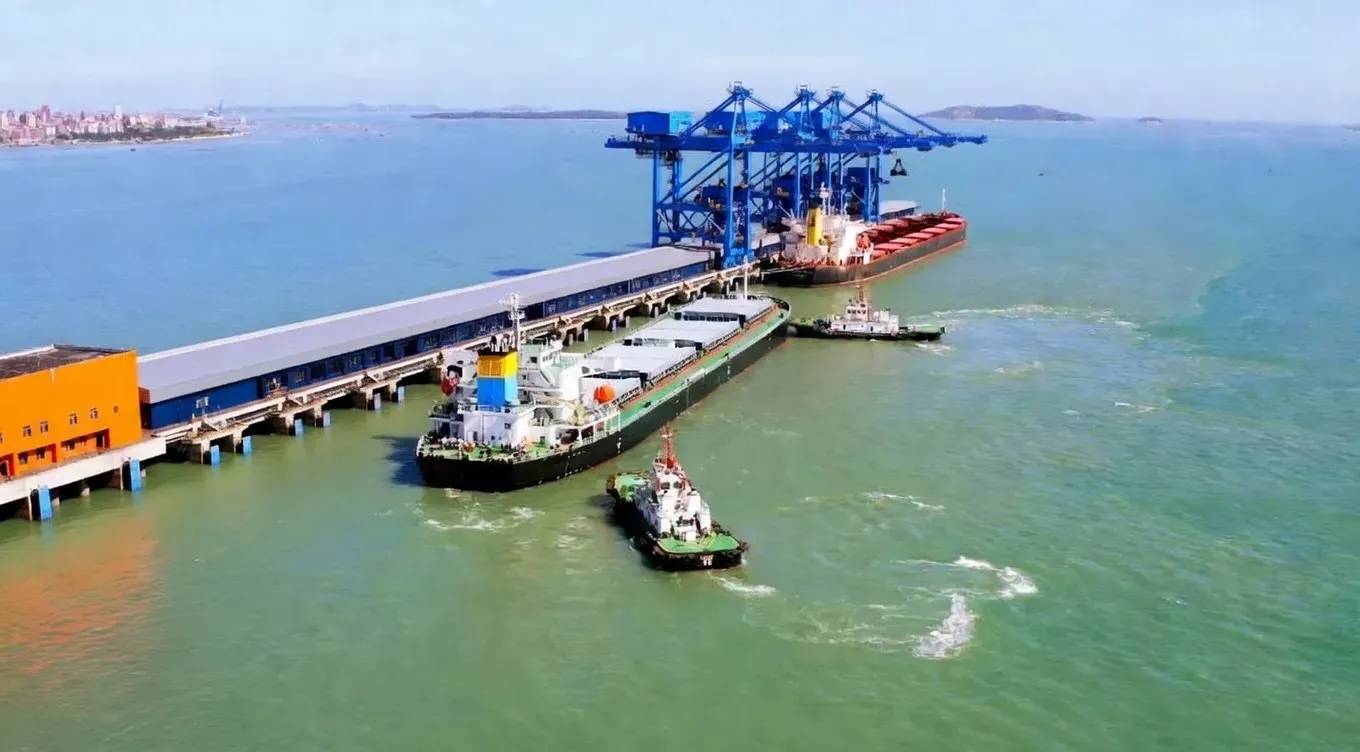
UK bulk ports — handling coal, grain, fertiliser, aggregates, and recycled materials — operate level-luffing cranes, portal cranes, and mobile harbour cranes where hoisting chains face both high cyclic loads and highly abrasive cargo environments. Fine cargo particles can pack into inter-link clearances, creating an abrasive grinding action that accelerates wear far beyond normal predictions. Mega Chain bulk terminal hoisting chains are specified with enhanced surface hardness treatments and optimised inter-link clearances that resist contamination packing. Terminals at Immingham, Teesport, and the Port of Tyne represent the kind of demanding UK bulk facility where this specialised hoisting chain capability delivers measurable operational benefit.
Emergency Replacement & Scheduled Maintenance
Even with best-practice maintenance programmes, unexpected hoist chain retirement or emergency replacement can be triggered by overload events, damage from foreign object contact, or maintenance interval extension beyond safe limits. When a quay crane hoist chain requires urgent replacement, every hour matters: container terminal throughput losses accumulate rapidly once a crane is out of service. Mega Chain UK stocking arrangements ensure that emergency replacement chains in the most common pitch, grade, and length combinations can be confirmed and dispatched same working day to port locations anywhere in Great Britain, minimising the operational downtime window.
Customer Success: How UK Ports Solved Chain Challenges with Mega Chain
The strongest evidence for any industrial product’s performance is the measurable outcome experienced by customers who have made the switch in real operational conditions. The following case studies represent actual project profiles from UK port environments — identifying the challenge, the Mega Chain solution deployed, and the quantified outcome delivered.
Port of Southampton Container Terminal — Doubling Planned Maintenance Intervals
A leading container terminal operator at the Port of Southampton reported persistent hoist chain fatigue failures on a fleet of four STS quay cranes. The incumbent chain supplier had been unable to achieve maintenance intervals exceeding 14 months before chain retirement became mandatory following visible link wear and elongation measurements.
Mega Chain application engineers reviewed the crane duty data, reeving configuration, and historical wear patterns. A transition from Grade 80 to Grade 100 hoisting chain was recommended, with hot-dip galvanised surface treatment matched to the Southampton waterfront exposure category.
Maintenance intervals achieved post-implementation — against a previous 14-month average. Annual chain replacement cost reduced by approximately 40%.
East of England Bulk Port — Conquering Abrasive Cargo Chain Wear
An East of England bulk port handling approximately eight million tonnes of aggregate and recycled construction material annually was experiencing accelerated hoisting chain wear on portal cranes due to abrasive cargo contamination packing between inter-link contact surfaces, with chain elongation reaching retirement threshold at just 12 months.
Mega Chain supplied a bespoke hoisting chain with increased inter-link clearances and a proprietary hard-chrome inter-link surface treatment developed specifically for abrasive bulk cargo environments — combined with a revised lubrication protocol for the crane’s automatic lubrication system.
Chain elongation remained within serviceable limits at 18-month inspection — a 50% extension of the previous retirement cycle with demonstrable wear rate reduction.
Scottish Ro-Ro Terminal — Non-Standard Pitch Custom Chain with Lloyd’s Certification
A roll-on/roll-off ferry terminal on the west coast of Scotland operating a heavy-lift quay crane for specialised project cargo handling required a replacement hoisting chain in a non-standard European pitch — unavailable from any UK catalogue stock supplier. Lloyd’s Register witness test certification was required by the terminal’s marine underwriters.
Mega Chain’s custom manufacturing capability enabled rapid production of 44 metres of the required non-standard-pitch Grade 100 hoisting chain, with Lloyd’s Register witness testing conducted at Mega Chain’s facility and full documentation package issued including material test certificates and serialised proof load records.
Lead time from confirmed order to delivery at the Scottish terminal — including Lloyd’s Register witness testing — far exceeding the client’s expected timeline for a certified custom chain.
What UK Port Engineers Say About Mega Chain
We have been running Mega Chain hoisting chains on our container cranes for three years now. The extension of our maintenance interval has been transformative operationally — we plan the crane out of service at 26 months rather than scrambling for replacement chain every 12. The certification documentation meets all our ISO 9001 audit requirements without any back-and-forth. It is the kind of product and supplier relationship that makes a maintenance engineer’s job substantially easier.
Specifying crane components at this scale is about total cost of ownership, never just purchase price. Mega Chain’s application engineers provided a detailed technical justification for their Grade 100 recommendation — including duty classification analysis and fatigue life calculations — that our previous supplier had simply never offered. Two years into operation, the financial case has proven itself. I would not hesitate to recommend Mega Chain to any UK port operator assessing their hoisting chain supply.
When our hoist chain required urgent replacement during an active cargo operation, we needed a certified chain fast and without any procurement ambiguity. Mega Chain had a custom-length, fully documented Grade 100 chain dispatched within 24 hours. That response — and the quality of the product and its paperwork — is exactly what earns long-term approved supplier status in our organisation. They understand how a working port operates.
Supplying UK Port Operations from Felixstowe to the Clyde
The United Kingdom’s port infrastructure spans a remarkably diverse geography — from the deep-water container terminals of the Southeast and East Anglia to the bulk handling facilities of the Northeast coast, the Humber estuary, the Mersey, the Bristol Channel, and the extensive Scottish west coast network serving both commercial and energy sector logistics. Each of these operational environments presents distinct challenges for quay crane hoisting chain specification and supply.
Felixstowe, Thamesport, Tilbury — high-frequency container duty cranes in high-salinity coastal exposure. Grade 100 / Grade 120 hoisting chain with enhanced galvanising.
Southampton, Portsmouth — multi-purpose and container crane applications requiring broad specification range, same-day emergency dispatch capability to serving berths.
Immingham, Teesport, Port of Tyne — bulk cargo environments requiring abrasion-resistant hoisting chain variants and extended inter-link clearance specifications.
Glasgow, Greenock, Fort William — specialised heavy-lift, energy sector, and ferry terminal cranes often requiring custom pitch chains and classification society certification.
Mega Chain maintains UK-based commercial and technical support capability, with stocking arrangements enabling rapid delivery to port locations throughout England, Wales, and Scotland. For terminals with planned maintenance management systems, Mega Chain can be registered as an approved supplier under pre-negotiated framework agreements — covering standard chain specifications, certification requirements, lead time commitments, and emergency call-off provisions. UK engineers can contact our technical team directly at [email protected] for same-day responses to urgent operational requirements across any UK port region.
Custom Hoisting Chain Solutions from Our Manufacturing Floor
The manufacturing capability behind every Mega Chain hoisting chain is a fully integrated production facility equipped with modern chain-making machinery, an in-house metallurgical and mechanical testing laboratory, and a dedicated quality assurance department operating to ISO 9001:2015. This vertical integration — from wire drawing through precision link forming, flash welding, heat treatment, surface coating, and proof loading to final inspection and certification — gives Mega Chain complete control over every parameter that determines hoisting chain performance in a demanding port environment.
For UK port operators with requirements that fall outside standard catalogue specifications, this manufacturing depth translates directly into genuine, engineered customisation capability — not simply a different cut length, but a genuinely adapted product. Mega Chain’s engineering team regularly develops bespoke hoisting chain solutions for clients: non-standard pitches to match legacy European crane equipment; custom end terminations precisely engineered to interface with existing crane suspension hardware; and complete multi-component hoist assemblies incorporating chain, masterlinks, connecting hardware, and load pins as a pre-proof-loaded, certified and serialised assembly ready for direct crane installation.
Our Customisation Capabilities
- Non-standard pitch chains (any pitch on request)
- Custom lengths cut to the nearest link
- Bespoke end terminations & masterlinks
- Multi-component hoist assemblies, proof-loaded as unit
- Classification society witness testing (LR, BV, DNV)
- Special surface treatments for extreme environments
- UK framework agreements & stocking arrangements
- Early-stage crane design consultation
Reply within 1 working day · UK port delivery available
Frequently Asked Questions About Mega Chain Quay Crane Hoisting Chain
What is the typical service life of a Mega Chain hoisting chain on a quay crane operating in a UK coastal port environment with salt air exposure?
Service life depends on duty classification, peak loading, maintenance programme quality, and environmental exposure. In typical UK container terminal conditions — FEM 4m duty, salt air coastal exposure, well-maintained hoist systems with correct lubrication — Grade 100 Mega Chain hoisting chains consistently achieve planned maintenance intervals of 20 to 31 months before chain retirement. Chains operating in abrasive bulk cargo environments or at FEM 5m duty classifications may require shorter intervals. Our application engineers can calculate expected retirement intervals from your specific crane operational data. Contact [email protected] to discuss your crane’s duty profile.
How do I choose between Grade 80, Grade 100, and Grade 120 hoisting chain for my shore bridge crane lifting application in the UK?
Grade selection depends on the crane’s rated hoist capacity, FEM duty classification, the number of falls in the reeving system, and any dynamic load factors specific to the cargo type handled. Mega Chain application engineers confirm the correct grade from your crane’s specification documentation. Upgrading from Grade 80 to Grade 100 is a common and cost-effective improvement for cranes originally designed around Grade 80 chain — it delivers a meaningful increase in safety factor and fatigue life with no change in chain physical dimensions. For very high duty cranes or where maximum maintenance interval extension is the priority, Grade 120 should be evaluated.
Where can I buy EN 818-7 certified quay crane hoisting chain with Lloyd’s Register approval from a supplier who delivers directly to UK ports?
Mega Chain supplies EN 818-7 compliant hoisting chain with CE marking and third-party test certification from Lloyd’s Register, Bureau Veritas, or DNV as required on each order. We deliver directly to UK port addresses — including delivery to specific crane maintenance workshops within operating port estates. For urgent orders, same-day dispatch from UK stocked items is available on standard specifications. Contact [email protected] with your chain pitch, grade, required length, certification requirement, and delivery location for a formal quote.
How much does a custom-length replacement quay crane hoisting chain typically cost, and what factors affect the price for UK port operators?
Price is determined by chain grade, nominal pitch, total length, surface treatment specification, and certification requirements. Higher chain grades and longer continuous lengths reduce unit cost per metre. Third-party classification society certification adds to the total cost but is often a mandatory requirement for insurance compliance and is non-negotiable in those contexts. Mega Chain provides fully itemised, transparent quotations for all orders. For a budget price indication, email [email protected] with your basic chain dimensions and we respond within one UK working day.
What are the warning signs that a quay crane hoist chain needs replacing before it causes costly downtime or a safety event at a UK port?
Primary retirement criteria for hoisting chains include: link elongation reaching the manufacturer’s retirement limit (typically 2–3% of nominal pitch — measured across ten links); cross-section diameter wear reduction exceeding 10–12% of nominal diameter; and visible damage including cracks, corrosion pitting, distorted links, or worn contact surfaces at the sheave interface. ISO 4309 and FEM 9.511 both provide standardised inspection and retirement criteria. Mega Chain supplies chain retirement criteria documentation with every delivery, and our engineers can advise on appropriate inspection intervals matched to your specific operational duty profile and environmental exposure conditions.
What is the typical lead time for a non-standard pitch quay crane hoisting chain with Bureau Veritas certification delivered to a port in Northern England?
Custom-length chains without third-party classification society witness testing are typically ready for dispatch within 10–15 working days of confirmed order. Where Bureau Veritas, Lloyd’s Register, or DNV witness testing is required, total lead times extend to 20–30 working days depending on surveyor scheduling availability. Emergency replacement chains in standard pitch/grade combinations can often be dispatched same working day from UK stock. Contact us with your specific chain details and we will confirm the exact production and delivery lead time for your order at no obligation.
How should a quay crane hoist chain be lubricated and inspected at a UK container terminal to maximise its operational service life?
Hoisting chains should be lubricated at intervals determined by operational hours and environmental conditions — more frequently in high-salt coastal environments. Chain lubricants must penetrate the inter-link bearing surfaces rather than coating only the external surface; automatic lubrication systems integrated with the crane hoist mechanism are preferred for STS crane applications with high cycle frequencies. Mega Chain recommends a minimum visual inspection every 500 operational hours and a formal dimensional inspection against published retirement criteria at each planned maintenance interval. A detailed lubrication and maintenance protocol document is included with every Mega Chain delivery package.
Can Mega Chain supply a complete hoisting chain assembly including masterlinks and end terminations for a quay crane at a UK port, proof-loaded and certified as a unit?
Yes. Mega Chain manufactures complete hoisting chain assemblies incorporating the chain, masterlinks, connecting links, swivel hooks, and any bespoke end terminations specific to your crane model — all produced in-house, assembled, and proof-loaded as a complete unit before dispatch. Each assembly is issued with a single certificate of conformity covering the entire lifting unit to EN 818-7 or the applicable standard. This eliminates the risk of undetected compatibility issues between separately sourced components and significantly simplifies your crane maintenance documentation. Enquire at [email protected] with your crane model or suspension hardware drawing for a customised assembly proposal.