
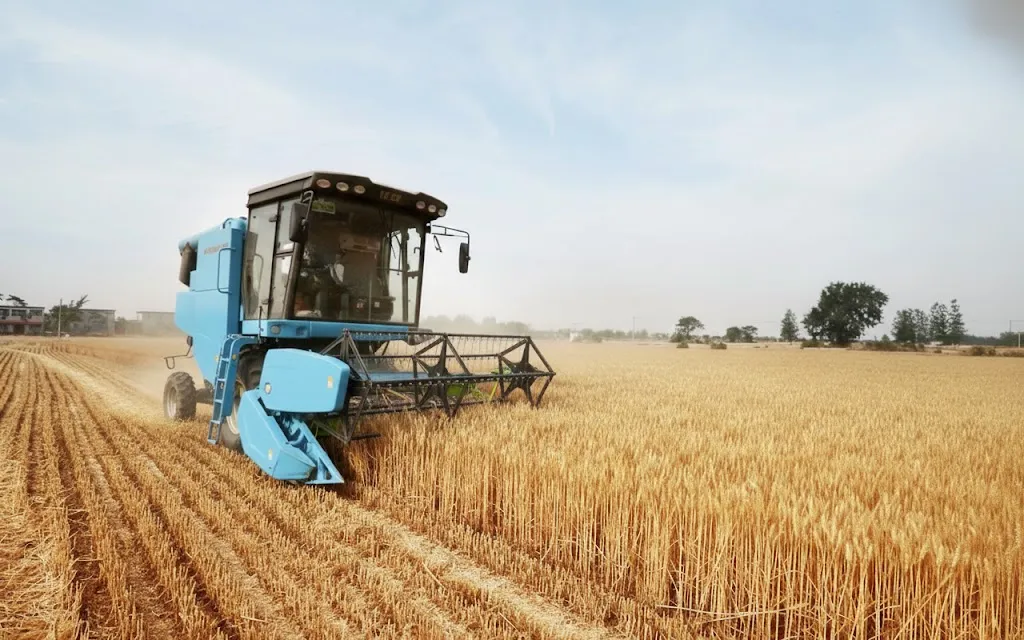
 Large combine harvesters are the engine room of UK cereal and oilseed production. Platforms such as the John Deere X9 1100, Claas Lexion 8900, New Holland CR10.90, and Case IH Axial-Flow 9250 are capable of processing well over 80 to 100 tonnes of grain per hour under peak conditions. At the heart of each machine’s grain handling circuit lies a component that rarely receives the attention it deserves until it goes wrong: the grain conveying chain. This chain, together with its paddles and flights, moves harvested grain from the separation area through vertical elevators, along horizontal drag conveyors, and ultimately into the grain tank. When it stretches, cracks, or snaps mid-harvest, the entire operation stops cold. The engineering team at Mega Chain has spent more than 18 years designing and refining grain conveying chains that are precision-built for these demanding agricultural environments, with performance validated through real-world field testing across multiple UK and European harvest seasons covering diverse crop types and soil conditions.
The agricultural machinery replacement parts market in the United Kingdom is increasingly demanding solutions that go beyond generic catalogue items. Today’s high-capacity combine harvesters run grain conveying systems under enormous and continuous mechanical stress — paddles and flights on the chain must endure grain impact forces, contact with small stones and crop debris, and the thermal cycling of a long British harvest day that may stretch from 06:00 to 22:00 or beyond. A poorly specified chain stretches beyond acceptable tolerances within just a few hundred operating hours, leading to sprocket misalignment, blockages at the elevator head, and ultimately catastrophic failure at the worst possible moment. Mega Chain’s grain conveying solutions are engineered to address every one of these failure modes through advanced metallurgy, precision heat treatment, and geometric design optimised for the specific pitch and sprocket configurations of today’s dominant UK combine harvester platforms.
Why Grain Conveying Chains Fail in High-Capacity UK Combine Operations
 Understanding the precise failure modes of grain conveying chains in UK harvest conditions is the foundation of specifying the right replacement solution. In large-scale arable farming environments — from the flat Fenlands of Cambridgeshire to the rolling chalk downlands of Wiltshire — grain conveying chains face a uniquely punishing combination of operating variables. High grain throughput volumes create sustained tension loads in elevator chains that approach the working load limit of lower-grade products. Simultaneously, weed seeds, grit particles, and crop debris infiltrate the pin-bushing joint, acting as an abrasive medium that accelerates internal chain wear at a rate that would not occur in a clean industrial environment. Chain pitch elongation of just 2% is sufficient to cause sprocket tooth jumping under load, generating destructive impact forces that exponentially accelerate the rate of further damage. This cascade failure mechanism is responsible for the majority of mid-harvest chain breakages seen on UK farms.
Thermal fatigue is an equally significant and frequently underestimated challenge for grain conveying chains operating on UK combine harvesters. A British harvest day may begin with the combine running in cool morning air with high-moisture crop, then transition through the heat and dust of a dry afternoon, and continue into the evening as temperatures drop again. The chain cycles through thousands of load-and-release events every hour across this varying temperature range. Low-quality chains manufactured from standard carbon steel without appropriate case hardening develop micro-cracks in the link plates under this cyclic bending stress, eventually leading to sudden brittle fracture — most likely during the highest-load period of peak afternoon harvesting. Mega Chain addresses this failure mode through a combination of precisely controlled alloy steel composition, deep carburising heat treatment cycles, and shot-peened link plates that carry built-in residual compressive stress specifically designed to resist fatigue crack initiation. The result is a grain conveying chain that maintains its structural integrity across multiple UK harvest seasons rather than demanding replacement after every one.
Key Engineering Advantages of Mega Chain Grain Conveying Chains
Six Performance Pillars That Set the Standard
Precision Heat Treatment
Every Mega Chain grain conveying chain undergoes a 16–22 hour controlled-atmosphere carburising cycle followed by oil quench and temper to achieve surface hardness of HRC 58–62 with a tough, ductile core. This dual-phase metallurgical structure resists both surface abrasion from grit-laden grain streams and subsurface fatigue from the continuous cyclic bending loads of an elevator chain in operation — a performance balance that generic catalogue chains consistently fail to deliver across a full UK harvest season.
Anti-Elongation Shot-Peened Link Plates
Mega Chain’s high-tensile alloy steel link plates are shot-peened after heat treatment to introduce a controlled compressive residual stress layer across the plate surface. This engineered stress field directly opposes the tensile stresses that drive fatigue crack initiation, extending link plate life by measurable margins validated in cyclic fatigue testing. Combined with a breaking load 30–40% above standard specification, the result is a grain conveying chain that retains accurate pitch across the entire harvest season without requiring mid-season tensioner re-adjustment.
Sintered Bushing Internal Lubrication
Available on heavy-duty and ultra-performance grades, sintered porous bushings retain lubricant within the pin-bushing contact zone throughout the chain’s complete operational life without external re-greasing. This technology reduces internal wear rate by up to 60% compared to conventionally pre-lubricated chains operating in dusty grain conveying environments, directly extending service intervals and lowering the total cost of ownership for UK combine operators managing large fleets across demanding arable seasons.
OEM-Compatible ±0.05 mm Pitch Accuracy
All Mega Chain grain conveying products are manufactured to ±0.05 mm pitch tolerances, ensuring direct compatibility with OEM sprockets on John Deere, Claas, New Holland, Case IH, and Massey Ferguson combine platforms without modification or shimming. This level of dimensional precision eliminates the polygonal effect — the characteristic vibration and shock loading that occurs when a slightly off-pitch replacement chain engages sprocket teeth unevenly — protecting both the new chain and the existing sprocket investment simultaneously.
Corrosion-Resistant Multi-Layer Surface Treatment
British harvest conditions involve early-morning dew, high-moisture crops, and frequent rain interruptions that leave combine components exposed to surface corrosion during stand-down periods. Mega Chain applies an electro-zinc phosphate conversion coating followed by specialist anti-corrosion wax impregnation to all grain conveying chain products, providing robust protection during off-season storage and early-season operation when condensation levels are at their highest. This treatment adds no dimensional change to the chain geometry while meaningfully extending component life.
Custom Paddle & Flight Attachment Systems
The grain-contacting surface of any conveying system is only as good as its attachment configuration. Mega Chain offers bolt-on rubber-tipped paddles for gentle grain handling in vertical elevator applications, hardened steel flights for high-speed horizontal drag conveyors, and hybrid composite attachments that combine abrasion resistance with reduced grain damage potential. All attachment plates are FEA-optimised to distribute load away from the link plate perforation, preventing the localised cracking that causes premature failure when generic attachment hardware is used in heavy-throughput agricultural applications.
Technical Performance Parameters — Grain Conveying Chain Range
The table below summarises the core technical parameters across Mega Chain’s three grain conveying chain grades for large combine harvester applications. All figures are derived from controlled test-bench measurements and cross-validated against field performance data gathered over multiple UK and Northern European harvest seasons. Specifications outside the ranges listed — including non-standard pitches, extended attachment spacings, or specialist corrosion treatments — are available through our custom engineering service. Contact our technical team for detailed application-specific consultation before selecting the appropriate grade for your specific combine model and harvesting conditions.
| Parameter | Standard Grade | Heavy-Duty Grade | Ultra-Performance Grade |
|---|---|---|---|
| Chain Pitch | 38.1 mm / 50.8 mm | 38.1 mm / 50.8 mm | Custom pitch available |
| Minimum Breaking Load | 68 kN | 92 kN | 120 kN |
| Link Plate Alloy Steel Grade | 45Mn / Boron steel | 20MnCr5 | 30CrMnSi (boron-treated) |
| Pin Surface Hardness | HRC 56–58 | HRC 58–62 | HRC 60–64 |
| Pitch Elongation at Replacement Limit | ≤ 2.0% | ≤ 1.5% | ≤ 1.2% |
| Operating Temperature Range | -20°C to +80°C | -30°C to +100°C | -40°C to +120°C |
| Expected Service Life (UK field) | 1,200–1,500 hrs | 2,000–2,500 hrs | 3,000+ hrs |
| Internal Lubrication Option | Pre-lubricated | Sintered bushing | Sintered bushing + oil reservoir |
| Surface Treatment | Zinc phosphate + wax | Electro-zinc + anti-corrosion oil | Nickel-alloy plating + wax seal |
| Compatible Harvester Platforms | John Deere, Massey Ferguson | + Claas, New Holland, Case IH | All brands — full custom |
Engineering Principles: Materials, Construction, and Grain Chain Technology
 The science underpinning a high-performance grain conveying chain begins at the alloy selection stage. Mega Chain specifies 20MnCr5 and 30CrMnSi alloy steels for its heavy-duty and ultra-performance grades — materials that provide an optimal combination of tensile strength, toughness, and case-hardenability. During manufacture, link plates and pins are machined from precision-drawn bar stock, then subjected to a controlled-atmosphere carburising process in which carbon is diffused into the surface layer to a depth of 0.4–0.8 mm across a 16–22 hour furnace cycle. Components are then oil-quenched from carburising temperature and tempered at controlled temperatures to achieve the specific hardness and toughness profile required. This is not a condensed process; the full thermal cycle is never shortened to reduce production time, ensuring that every batch achieves uniform properties throughout. The finished result is a hard, wear-resistant surface layer bonded to a tough, impact-absorbing core — a combination that standard carbon steel chains simply cannot replicate regardless of the quality of downstream assembly.
Assembly precision at Mega Chain’s manufacturing facility is held to tolerances that rival precision industrial gearbox components. Hydraulic chain assembly presses are calibrated to 0.01 mm accuracy for pin-fitting operations, ensuring that the interference fit between pin and outer plate is consistent across every link in the chain. This consistency eliminates the weak points that develop in chains assembled to loose tolerances, where variable interference fits allow relative movement between pin and plate under load. Each completed grain conveying chain undergoes tensile pre-stressing before despatch — a process in which the chain is loaded to 30% of its rated breaking load for a defined number of cycles. This pre-stresses all pin-bushing and pin-plate contact interfaces, eliminating the initial settlement elongation that occurs in new chains during the first hours of operation. A Mega Chain product therefore arrives on the farm already dimensionally stable and ready to operate at specified pitch accuracy from the very first hour of harvest.
The paddle and flight attachment hardware that forms the grain-contacting working surface of any conveying system deserves equal engineering attention to the chain itself. Mega Chain designs its K-type and A-type attachment plates using finite element analysis to identify and eliminate stress concentration regions around bolt holes and plate perforations. The geometry of every attachment plate is optimised to transfer load through the plate body rather than through the perforation edge, directly preventing the form of localised cracking that causes premature attachment plate failure in high-throughput agricultural applications. Rubber-tipped paddle attachments are manufactured from abrasion-resistant natural rubber compounds bonded to a galvanised steel backing plate, providing both gentle grain handling and long wear life in applications where grain quality and conveying efficiency must be maintained simultaneously.
Application Scenarios: Where Mega Chain Grain Conveying Chains Perform
The grain conveying system in a large combine harvester is not a single-chain application — it is a series of interconnected conveying stages, each placing different mechanical demands on the chain running through it. Understanding where each chain operates and what specific load profile it experiences is critical to specifying the correct product for each position. Mega Chain’s application engineering team routinely works with UK machinery dealers and direct farm customers to map the complete grain conveying pathway and match the appropriate chain grade and configuration to each individual position in the system.
Grain Tank Primary Elevator
The main elevator chain carries clean grain vertically from the returns pan to the grain tank, typically operating at 600–900 rpm under the highest tension loads in the system. This is the single most critical grain conveying chain position on any large combine. Mega Chain heavy-duty grade with sintered bushing lubrication is the validated recommendation for John Deere X9, Claas Lexion, and New Holland CR10 primary elevator applications across UK arable conditions.
Tailings Returns Elevator Chain
The tailings returns elevator re-processes incompletely threshed material — a mix that is significantly heavier and more abrasive than clean grain, containing crop stems, unthreshed heads, and soil particles. Impact loading in this position can be extreme when harvesting high-yielding crops with heavy straw in wet seasons. Mega Chain’s standard boron-steel grade with K-type reinforced attachment flights is the cost-effective, high-durability specification recommended for this position.
Cross-Auger Distribution Chain
Horizontal distribution chains spread grain across the full grain tank width, operating at lower chain speeds but under significant lateral grain pressure. Consistent pitch across the full chain width is critical in this position — uneven stretch between left and right link plates causes the chain to track laterally, resulting in grain spillage outside the tank and inefficient capacity utilisation. Mega Chain’s matched-pair link plate selection process ensures lateral stiffness uniformity throughout service life.
Header Drive & Feeder Chains
Chain drives within the header and feeder house transmit power to knife drives, reel motors, and the threshing drum feed roller in many large combine configurations. These chains operate under shock loads from stony ground contact, dense crop matting, and sudden engagement events, demanding the maximum available fatigue resistance. Mega Chain ultra-performance grade with shot-peened alloy link plates is the recommended solution for header drive positions across UK arable conditions.
Supplying the UK Agricultural Machinery Sector
From East Anglia to Scotland — from Independent Farms to Machinery Dealer Networks
Customer Success Case: Brentwood Grain Farms Ltd, Cambridgeshire, UK
Company
Brentwood Grain Farms Ltd
Location
Cambridgeshire Fens, East of England
Harvester Fleet
3 × John Deere X9 1100 & 1 × Claas Lexion 8800
Annual Crop Area
2,800 ha — wheat, barley, oilseed rape
1The Challenge
Brentwood Grain Farms had been experiencing recurring grain elevator chain failures during the critical August–September harvest window. Operating four large combine harvesters across more than 2,800 hectares in the Cambridgeshire Fens, the operation processed in excess of 4,500 tonnes of grain over a three-week harvest. During the 2022 season, two separate mid-harvest primary elevator chain failures caused cumulative downtime of over 14 hours across the fleet, at a period when crop conditions allowed only a narrow daily harvesting window due to early-morning dew. Farm manager Richard Clarkson estimated the combined cost of emergency repair call-outs, grain quality penalties from delayed tank emptying, and lost harvesting time at approximately £28,000. The chains being used were sourced from a general agricultural parts distributor at low cost, and had been giving consistent service intervals of less than one full season. Clarkson contacted Mega Chain in March 2023 following a recommendation from the local John Deere dealer who had observed the problem pattern across several Cambridgeshire farms using the same generic chain supplier.
2The Mega Chain Solution
Mega Chain’s application engineering team conducted a comprehensive grain conveying system review across all four combines, including physical inspection of worn chain samples, sprocket tooth wear analysis, drive shaft alignment checking, and a review of the operator’s tensioner adjustment records. The root cause of repeated failures was identified as a two-factor combination: the generic chains were specified below the load rating required by the John Deere X9’s high-throughput separator, and the dimensional inconsistency of the chain pitch was causing uneven sprocket engagement that generated localised shock loads far exceeding the chain’s rated capacity. Mega Chain supplied a complete chain replacement package for all four machines, specifying heavy-duty grade 50.8 mm pitch primary elevator chains with sintered bushing lubrication for the X9 machines, heavy-duty 38.1 mm pitch chains for the Lexion 8800 elevator, and standard boron-steel grade chains for all four tailings returns positions. A pre-harvest installation service was also provided to ensure correct tensioner adjustment and sprocket alignment on all machines before the season began.
3The Results
Throughout the entire 2023 harvest season, Brentwood Grain Farms completed their full 2,800-hectare programme with zero grain conveying chain failures across all four machines — the first failure-free harvest the operation had recorded in four years. Post-season inspection of the primary elevator chains on all three John Deere X9 combines showed pitch elongation measurements below 0.8% after 340 operating hours, placing them well within the 1.5% replacement threshold and confirming at least one, and likely two, further full harvest seasons before replacement would be required. Richard Clarkson calculated the total financial benefit versus the previous two-season average at approximately £45,000, accounting for eliminated downtime costs, zero emergency repair call-outs, and avoided grain quality penalties. Brentwood Grain Farms has since extended its supply arrangement to cover header drive chains and cross-distribution system chains across the entire fleet, and has committed to advance stocking orders for the 2024 and 2025 harvest seasons.
What UK Agricultural Operators Say About Mega Chain
Verified feedback from UK farms & agricultural machinery dealers
“We have run Mega Chain grain elevator chains through two complete harvest seasons on our New Holland CR10.90 and the wear performance is genuinely impressive. The sintered bushing option was their engineering team’s recommendation based on our throughput figures, and it’s made a noticeable difference to chain stretch compared to anything we’ve used before. These chains won’t be going back to a catalogue supplier.”
James Whitfield
Farm Manager — Whitfield Arable Ltd, North Yorkshire
“As an agricultural machinery parts dealer in Lincolnshire we stock Mega Chain as our default replacement across all major combine brands. The pricing is competitive against OEM parts, lead times are consistent, and the dimensional accuracy is excellent — chains fit first time every time with no tensioner fiddling on the headland during harvest. That matters enormously to our farm customers.”
David Marsh
Parts Manager — Marsh Agricultural Machinery Ltd, Lincolnshire
“We operate five Claas Lexion 8900 combines on our Scottish Borders estate and had persistent problems with standard chains stretching excessively during high-moisture barley harvest. Mega Chain’s heavy-duty grade solved this completely. What set them apart was the willingness to go through our elevator configurations in detail before recommending the right product — something no other supplier had taken the time to do.”
Alistair Drummond
Operations Director — Drummond Estate Farms, Scottish Borders
Manufacturing Capability & Custom Chain Engineering Services
Mega Chain operates a fully integrated manufacturing facility covering the complete production pathway for agricultural grain conveying chains — from raw material procurement and precision machining through heat treatment, assembly, pre-stressing, surface treatment, and final quality inspection. The production floor is equipped with CNC multi-axis machining centres, automated controlled-atmosphere heat treatment furnaces with real-time carbon potential monitoring, hydraulic chain assembly presses calibrated to 0.01 mm accuracy, and a dedicated quality laboratory running tensile testing, hardness measurement, pitch measurement, and metallographic analysis on every production batch. This level of vertical integration ensures that Mega Chain controls every variable that influences the quality and consistency of the finished grain conveying chain, without relying on sub-contracted processes that introduce variability beyond our direct management.
The custom chain engineering capability at Mega Chain represents one of the most flexible and comprehensive offerings available to the UK agricultural machinery sector. Our engineering team regularly develops bespoke grain conveying chain solutions for applications that fall outside standard catalogue specifications — whether that is a non-standard pitch to match an older or unusual combine harvester model that OEM dealers no longer stock, a custom paddle geometry designed around a specific elevator’s flight spacing and bucket configuration, a specialised corrosion treatment for combines operating in coastal salt-air environments, or an extended-length chain assembly for a modified grain conveying pathway on a specialist machine. Minimum order quantities for custom-designed chain runs are negotiable, and we actively welcome conversations with customers who need small prototype batches for field evaluation before committing to production volumes. Our team has supported UK agricultural machinery manufacturers and dealers in Lincolnshire, East Anglia, Yorkshire, the Scottish Lowlands, and Wales with custom chain development projects, and we bring the same application-level depth of knowledge to every enquiry regardless of scale.
Frequently Asked Questions
Answers from our grain chain application engineering team
Ready to Eliminate Grain Chain Downtime on Your UK Farm or Business?
Contact Mega Chain’s application engineering team for a no-obligation technical consultation and competitive pricing on grain conveying chains for your combine harvester platform — whether you operate a single machine or a large multi-machine arable fleet.
Mega Chain · Industrial & Agricultural Chain Engineering · United Kingdom Supply · B2B Enquiries Welcome